Why Updating Mac Apps Is Harder Than It Looks
Update All can be convenient, but first check where each app came from, whether the package is trustworthy, and how you could restore the previous version. Skipping those checks can leave you with a license that no longer works, duplicate apps, or an incomplete installation.
Before updating, check how the app was installed and what you can do if replacement fails.
Three update channels with different rules
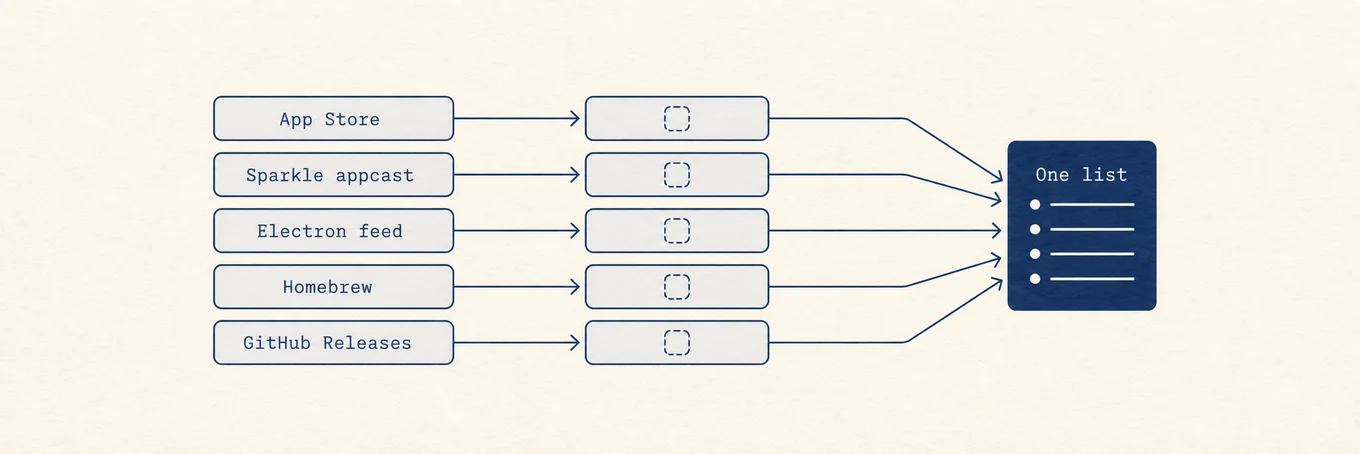
Mac software usually arrives through one of three surfaces. Each one has a different authority for upgrades.
| Channel | Who decides the next version | Typical failure mode |
|---|---|---|
| Mac App Store | Apple's store catalog for that Apple ID | Purchase, family sharing, or a newer macOS requirement prevents the app from updating |
| Developer download (Sparkle, Electron, custom) | The vendor's feed or download page | A mismatched package, a leftover helper, or a silent partial replace |
| Homebrew formula or cask | Homebrew's formula/cask metadata | A self-updater fights Homebrew, or a broad brew upgrade moves too much at once |
A fourth surface sits beside them: macOS Software Update. It does not replace Chrome, WhatsApp, or your design tools. Mixing system updates with app updates in one mental bucket is a common source of false confidence.
For the channel-by-channel how-to, see how to update Mac apps. This article is about judgment: when to wait, when to verify, and when a batch update is the wrong shape for the risk.
Why "newer" is not always "better today"
Security fixes usually deserve priority. Feature releases and major version jumps do not. Before you approve a row, check three facts:
- Release notes for breaking changes. Plugin hosts, audio tools, IDEs, and anything with signed binaries can invalidate a workflow overnight.
- Whether you can roll back. App Store history, a DMG you kept, a Time Machine snapshot, or a Homebrew pin need to be checked to confirm whether they can preserve or restore the previous version. Do not assume an older download will remain available.
- Whether anything else depends on this build. A pinned CI image, a client project, or a license tied to a build number can make "latest" expensive.
A quiet week before a deadline is a bad time for an opportunistic major upgrade. A quiet weekend after a backup is a better one.
One problem can affect several updates
Batch updates share accounts, download services, and installation steps. A failure in one of these can affect several apps.
| Shared risk | What it looks like | Safer habit |
|---|---|---|
| One blocked purchase stalls the list | A paid App Store update waits on Sign In or Buy, and the rest never start | Separate Store rows from free/verified downloads |
| One bad package poisons confidence | A failed replace leaves a half-updated bundle; you retry everything | Update critical apps one at a time first |
| Wrong channel overwrite | A website DMG lands on a Homebrew- or Store-managed copy | Confirm origin before replacing |
| Incomplete check treated as "no updates" | The UI still scanning looks empty | Wait for the check to finish before deciding |
Update feeds can also contain ambiguous information. Universal Purchase records, iOS-only versions, prerelease channels, and unusual version formats can be mistaken for Mac updates. If an update appears every day but never installs, investigate the cause before retrying.
Verify before you replace
For a developer-website package, verification is the difference between an update and an untrusted binary:
- Prefer HTTPS download pages you already trust, not a forwarded Discord link.
- Prefer packages the updater signed or checksummed, when the vendor publishes that proof.
- Prefer an in-app updater that replaces the same bundle identifier over a random zip dropped into
/Applications. - Quit the app and its helpers before replacing it so they do not keep writing files.
Homebrew has its own contract: brew outdated reviews, brew upgrade <token> applies. Some GUI casks also ship a self-updater. Running both without reading brew info is how you get two managers fighting over one .app.
A practical update order
- Back up, or confirm Time Machine / your usual snapshot is recent.
- Finish any App Store sign-in or purchase prompts on their own.
- Update the one or two apps you rely on today, then open them and smoke-test.
- Run the remaining low-risk updates as a batch.
- Leave anything with plugins, drivers, or "major" in the version bump for a deliberate window.
If an update fails, stop the batch. Retry that one app, read the vendor note, and only then continue. A cancelled or failed item should not be treated as proof that every other row is unsafe, but it is proof that your attention belongs on the failure first.
Where Mole fits
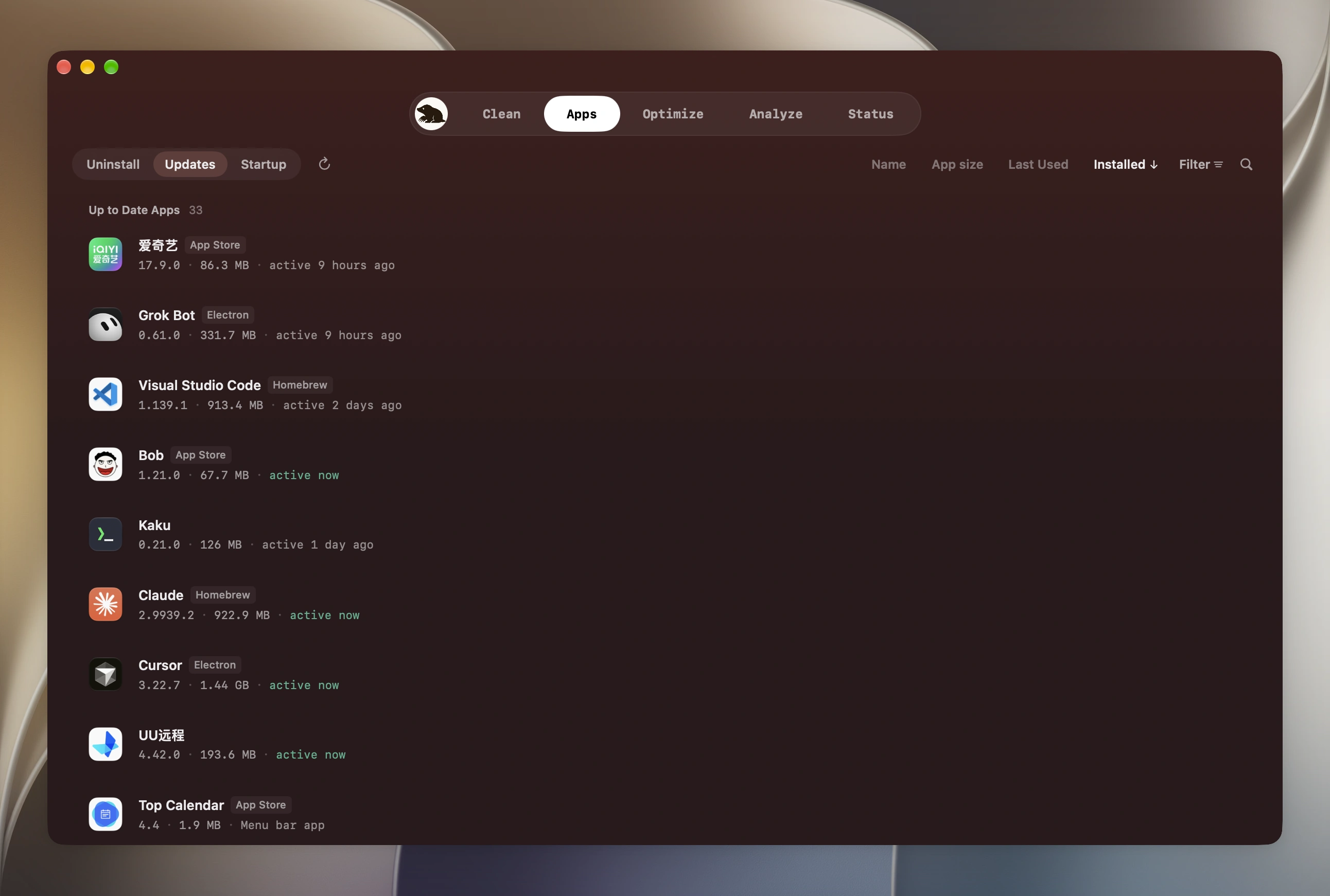
Mole's Software Updates list is built to make those decisions visible instead of hiding them behind a single progress bar. App Store and Sparkle-style updates can run together; a pending purchase does not have to hold up the rest; a failed or cancelled row can be retried without forcing every other app through the same path again. Website packages that need an explicit handoff stay explicit, and Mole verifies supported downloads before replacing the installed app when that path is available.
Update All is still a judgment call. Mole shows what you need to review: origin, progress, and failures stay attached to the app that owns them. For channel commands and Store vs Homebrew details, keep how to update Mac apps nearby.
FAQ
Should I enable every automatic updater?
Automatic updates are reasonable for browsers and other high-risk network clients when you trust the vendor channel. Keep major creative tools, audio plugins, and anything with a pinned project version on manual review.
Is Homebrew safer than a website DMG?
Neither is universally safer. Homebrew gives you a reviewable formula and a known upgrade command. A vendor DMG can be equally fine when it is signed, documented, and replaces the same app. Problems start when both channels manage the same install.
Why does an update keep showing after I installed it?
Common causes: the check finished against an old catalog, the on-disk bundle never changed, a helper is still the old build, or the feed is advertising a non-Mac or prerelease build. Confirm the version in the app's About window before retrying.
Does Mole replace App Store or Homebrew?
No. Mole coordinates discovery and supported install paths; App Store account rules and Homebrew ownership still apply. Use Mole to see what is pending, then let each channel finish under its own contract.